
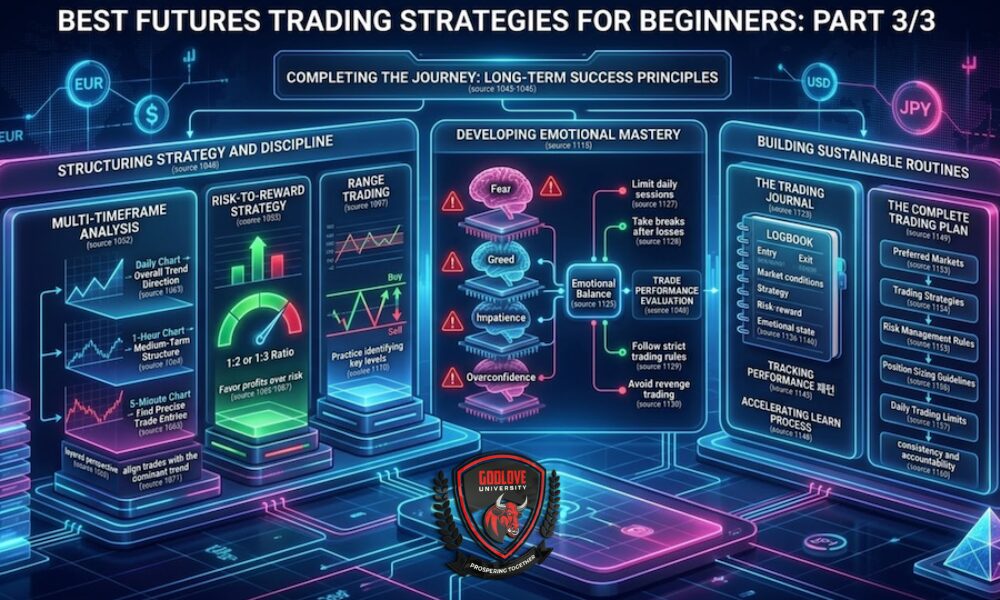
Best Futures Trading Strategies for Beginners explained. Discover advanced beginner methods, trading psychology, risk discipline, and long-term success principles for futures traders.
Introduction: Completing the Journey of the Best Futures Trading Strategies for Beginners
Learning futures trading is a gradual process. During the first article in this series, we explored the basic concepts of futures markets and introduced foundational strategies such as trend following and breakout trading. Then, in the second article, we examined intermediate techniques including pullbacks, support and resistance trading, and risk management principles.
Now, in this final installment, we will focus on the deeper elements that transform beginners into consistent traders. In fact, understanding the Best Futures Trading Strategies for Beginners involves much more than technical setups. Successful traders also master discipline, develop structured routines, and learn how to evaluate their performance over time.
Futures markets, especially those traded through major exchanges such as the
Chicago Mercantile Exchange,
move rapidly due to the participation of institutions, hedge funds, and professional traders. Because of this high activity, beginners who lack structure often struggle to remain consistent.
Consequently, this article explores several advanced beginner concepts that strengthen trading performance, including:
- Multi-timeframe analysis
- Risk-reward optimization
- Trading psychology
- Journaling and performance tracking
- Building a complete trading plan
By mastering these principles, beginners move closer to developing sustainable trading careers.
Multi-Timeframe Analysis Strategy
What Is Multi-Timeframe Analysis?
Multi-timeframe analysis involves studying the same market across different chart timeframes. Instead of relying on a single chart, traders examine larger timeframes for trend direction and smaller timeframes for entry signals.
For example:
- Daily chart → Identify overall market trend
- 1-hour chart → Observe medium-term structure
- 5-minute chart → Find precise trade entries
This layered perspective helps traders understand market context before placing trades.
Why Multi-Timeframe Analysis Improves Strategy Accuracy
Markets often behave differently depending on the timeframe being analyzed.
For instance, a short-term downtrend may occur within a larger long-term uptrend. Traders who ignore the larger trend sometimes enter trades that move against stronger market momentum.
By aligning trades with the dominant trend, traders often improve their probability of success.
Applying This Method in Futures Trading
Many traders use multi-timeframe analysis when trading popular futures markets such as:
- S&P 500 futures
- Nasdaq futures
- Gold futures
- Crude oil futures
These markets frequently display strong trends across multiple timeframes, making them ideal for this strategy.
Risk-to-Reward Strategy
Understanding Risk-to-Reward Ratios
Risk-to-reward ratio measures how much a trader risks compared with potential profit.
For example:
- Risk $100 to potentially earn $200 → 1:2 ratio
- Risk $100 to potentially earn $300 → 1:3 ratio
Many professional traders aim for ratios greater than 1:2, meaning potential profits are at least twice the size of the risk.
Why Risk-to-Reward Matters for Beginners
Even strong strategies produce losing trades. However, favorable risk-to-reward ratios help traders remain profitable despite occasional losses.
For instance:
Trades | Result |
4 losses at $100 each | −$400 |
2 wins at $300 each | +$600 |
Total result | +$200 profit |
Therefore, traders can still earn profits even with a lower win rate.
Using Risk-Reward in Trade Planning
Before entering any trade, disciplined traders evaluate:
- Stop-loss distance
- Profit target level
- Market volatility
If the potential reward does not justify the risk, many traders simply skip the trade.
Range Trading Strategy
What Is Range Trading?
While many strategies focus on trends, markets sometimes move sideways within defined price ranges.
Range trading involves buying near support levels and selling near resistance levels within these ranges.
Because prices repeatedly bounce between these boundaries, traders attempt to capture multiple smaller moves.
Recognizing Range-Bound Markets
Range markets typically display:
- Horizontal support levels
- Horizontal resistance zones
- Lower volatility
- Lack of strong trends
These conditions often occur before major breakouts.
Benefits for Beginner Traders
Range trading can help beginners practice:
- Identifying key price levels
- Managing short-term trades
- Using tight stop-loss orders
However, traders must remain cautious because strong breakouts can occur unexpectedly.
Trading Psychology: The Hidden Strategy
Why Psychology Determines Trading Success
Many beginners believe technical strategies determine success. In reality, trading psychology plays an equally important role.
Even the Best Futures Trading Strategies for Beginners fail if traders cannot control emotions such as:
- Fear
- Greed
- Impatience
- Overconfidence
Emotional decisions often lead to impulsive trades and excessive risk-taking.
Developing Emotional Discipline
Successful traders often develop routines that help maintain emotional balance.
These habits may include:
- Limiting daily trading sessions
- Taking breaks after losses
- Following strict trading rules
- Avoiding revenge trading
Discipline transforms strategies into consistent performance.
The Importance of a Trading Journal
What Is a Trading Journal?
A trading journal records every trade executed by a trader.
Typical journal entries include:
- Trade entry and exit prices
- Market conditions
- Strategy used
- Risk-reward ratio
- Emotional state during the trade
This information allows traders to analyze their performance objectively.
Why Journaling Improves Strategy Development
Over time, journals reveal patterns in trading behavior.
Traders may discover:
- Which strategies perform best
- Common mistakes that cause losses
- Market conditions that suit their style
Therefore, journaling accelerates the learning process.
Building a Complete Trading Plan
What Should a Trading Plan Include?
A trading plan acts as a roadmap guiding every decision in the market.
Effective trading plans typically include:
- Preferred markets
- Trading strategies
- Risk management rules
- Position sizing guidelines
- Daily trading limits
When traders follow a structured plan, emotional decisions become less likely.
Benefits of Structured Trading Plans
Trading plans create consistency and accountability.
Instead of reacting randomly to market movements, traders execute trades based on predefined rules.
Over time, this structured approach improves long-term performance.
Common Beginner Mistakes in Futures Trading
Even after learning the Best Futures Trading Strategies for Beginners, traders may still encounter challenges.
Common mistakes include:
- Overleveraging positions
- Trading too frequently
- Ignoring stop-loss orders
- Switching strategies too often
- Failing to track performance
Recognizing these mistakes early allows beginners to adjust their approach before significant losses occur.
FAQs About Best Futures Trading Strategies for Beginners
1. What is the most important skill for beginner futures traders?
Risk management is widely considered the most important skill for long-term trading success.
2. How long does it take to master futures trading strategies?
Most traders require months or years of practice to develop consistent performance.
3. Should beginners focus on one strategy or multiple strategies?
Beginners often benefit from mastering one strategy before expanding to additional methods.
4. Do futures traders rely only on technical analysis?
Many traders combine technical analysis with market news, economic data, and risk management techniques.
5. How can beginners improve their trading discipline?
Maintaining a trading journal and following a structured trading plan can significantly improve discipline.
6. Can futures trading become a full-time career?
Yes. However, reaching professional trading levels requires extensive experience, education, and consistent strategy execution.
Conclusion
Understanding the Best Futures Trading Strategies for Beginners involves far more than learning a few chart patterns. Successful futures traders combine technical strategies, risk management principles, psychological discipline, and continuous performance evaluation.
Throughout this three-part series, we explored the foundational tools needed to begin trading futures markets with confidence. Beginners who practice these strategies, maintain disciplined risk management, and refine their trading plans gradually develop the skills required for long-term success.
Ultimately, futures trading rewards patience, preparation, and persistence. By focusing on structured strategies and continuous improvement, beginners can transform early trading experiences into sustainable growth within the financial markets.
Useful Links
- Learn this and more with the Complete A to Z Forex & Futures Course
- Automate Your Trading with the Award Winning Patrex Pro Forex Bot