
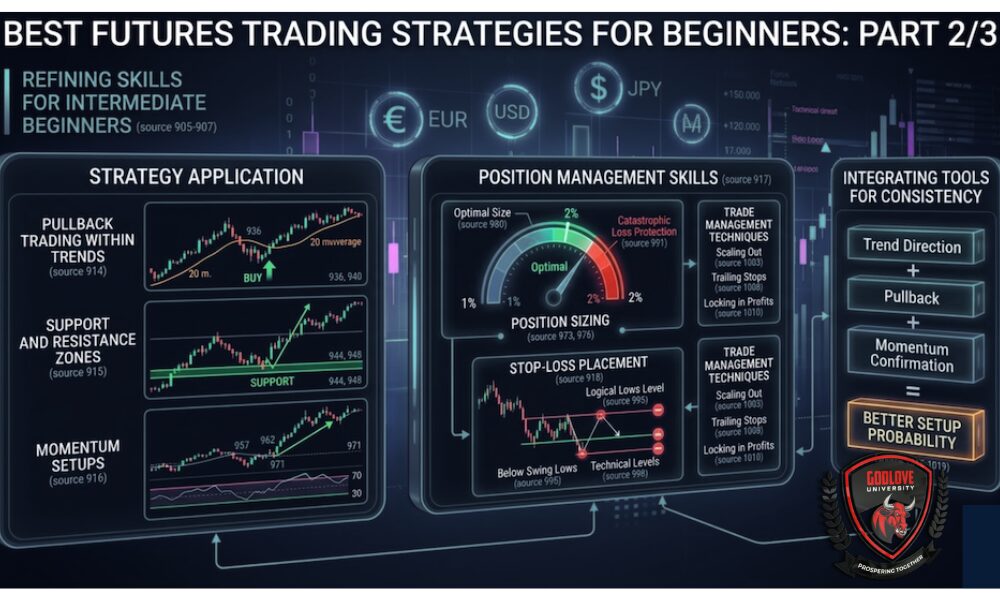
Best Futures Trading Strategies for Beginners explained. Learn intermediate trading techniques, position management, and risk control methods to improve consistency in futures trading.
Introduction: Developing Skill with the Best Futures Trading Strategies for Beginners
After understanding the foundations of futures trading and basic strategies such as trend following and breakouts, beginners often reach an important turning point. At this stage, traders start asking how to improve consistency, manage risk better, and refine their market entries. Consequently, learning more advanced methods becomes the next step when exploring the Best Futures Trading Strategies for Beginners.
Although simple strategies can produce results, successful traders eventually combine several tools to make better decisions. Instead of relying on a single indicator or chart pattern, they develop systems that integrate trend analysis, risk management, and timing techniques.
Furthermore, futures markets move quickly, particularly in high-volume contracts such as stock index futures traded through the
Chicago Mercantile Exchange.
Because of this speed, traders must refine their approach to avoid unnecessary losses.
Therefore, this second article in the series focuses on practical trading techniques that beginners can use to strengthen their strategies. Specifically, we will examine:
- Pullback trading within trends
- Support and resistance strategies
- Momentum-based setups
- Position sizing methods
- Stop-loss and trade management techniques
By mastering these intermediate techniques, beginners can transform simple strategies into structured trading systems.
Pullback Trading Strategy
Understanding Market Pullbacks
Markets rarely move in straight lines. Even during strong trends, price frequently retraces before continuing in the primary direction. These temporary reversals are known as pullbacks.
Pullback trading involves entering a trade during these short retracements rather than chasing the initial price movement.
For example, in an uptrend, price may temporarily fall toward support levels before continuing higher. Traders attempt to enter the market during this retracement to capture the next upward move.
Why Pullback Trading Works
Pullbacks often occur because traders take profits or institutions temporarily rebalance positions.
As a result, these temporary pauses provide opportunities for new traders to enter established trends.
Compared with chasing breakouts, pullback entries often provide:
- Better entry prices
- Smaller stop-loss distances
- Improved risk-to-reward ratios
How Beginners Identify Pullbacks
Common tools for identifying pullbacks include:
- Moving averages
- Trendlines
- Fibonacci retracement levels
- Previous support zones
Many traders wait for price to retrace toward a moving average before entering a trade aligned with the trend.
Support and Resistance Trading Strategy
What Are Support and Resistance Levels?
Support and resistance represent price zones where markets historically reverse direction.
Support refers to a price level where buying pressure tends to emerge. Resistance refers to levels where selling pressure appears.
Because many traders monitor these levels, they often become self-reinforcing.
How Traders Use Support and Resistance
Support and resistance strategies involve two common approaches:
- Trading reversals – entering trades when price bounces off key levels
- Trading breakouts – entering trades when price breaks through these levels
For beginners, identifying these zones helps them avoid entering trades at unfavorable price locations.
Why These Levels Matter in Futures Markets
Futures markets frequently react strongly to key levels due to high institutional participation.
Large trading firms and hedge funds often place orders around these levels, creating visible reactions on charts.
Consequently, beginners who learn to identify these zones gain an important advantage.
Momentum Trading Strategy
Understanding Market Momentum
Momentum refers to the speed and strength of price movements.
When momentum increases, markets often continue moving in the same direction for a period of time.
Momentum traders attempt to capture these rapid movements.
Common Momentum Indicators
Several indicators help traders measure momentum:
- Relative Strength Index (RSI)
- Moving Average Convergence Divergence (MACD)
- Stochastic oscillator
- Volume indicators
These tools help traders identify when markets are gaining or losing strength.
Momentum Trading for Beginners
Momentum strategies can be particularly effective during:
- Strong economic news events
- Market session openings
- Breakouts from consolidation ranges
However, beginners must be cautious because momentum trades can reverse quickly if market sentiment changes.
Position Sizing: One of the Most Important Trading Skills
Why Position Sizing Matters
Even the Best Futures Trading Strategies for Beginners will fail if traders use poor position sizing.
Position sizing determines how much capital a trader risks on each trade.
Without proper sizing, a few losing trades can quickly destroy an account.
A Simple Position Sizing Rule
Many professional traders follow a simple guideline:
Risk no more than 1–2% of total trading capital on a single trade.
For example:
- A $5,000 account risking 1% would risk $50 per trade.
- A $10,000 account risking 1% would risk $100 per trade.
This rule protects traders from large drawdowns during losing streaks.
Adjusting Position Size in Futures
Futures contracts have fixed sizes, so traders must choose contracts that align with their account size.
Fortunately, exchanges now offer micro futures contracts, which allow smaller traders to participate with reduced risk.
Stop-Loss Strategies for Futures Traders
Why Stop-Loss Orders Are Essential
Stop-loss orders automatically close a trade when price reaches a predetermined level.
These orders protect traders from catastrophic losses.
Without stop-losses, beginners often hold losing trades too long while hoping the market will reverse.
Common Stop-Loss Placement Methods
Several approaches help traders determine stop-loss locations:
- Below recent swing lows (for long trades)
- Above recent swing highs (for short trades)
- Fixed percentage of account risk
- Technical levels such as support or resistance
Using logical stop placements helps maintain disciplined trading.
Trade Management Techniques
Scaling Out of Trades
Some traders gradually exit positions rather than closing trades all at once.
This technique is known as scaling out.
For example:
- Close half the position at the first profit target
- Allow the remaining portion to run if the trend continues
Scaling out reduces risk while still allowing traders to benefit from larger moves.
Trailing Stop Strategies
Trailing stops adjust automatically as the market moves in the trader’s favor.
This technique allows traders to lock in profits while still giving the trade room to develop.
Many trend-following strategies rely on trailing stops to maximize winning trades.
Combining Strategies for Better Results
Experienced traders rarely rely on a single strategy.
Instead, they combine multiple tools to confirm trade setups.
For instance, a trader might look for:
- A trend direction
- A pullback toward support
- Momentum confirmation from an indicator
When several signals align, the probability of a successful trade often improves.
FAQs About Best Futures Trading Strategies for Beginners
1. What is the most reliable futures trading strategy for beginners?
Trend-following combined with pullback entries is often considered one of the most reliable beginner strategies.
2. Should beginners use multiple indicators?
Using too many indicators can cause confusion. Beginners should start with only a few simple tools.
3. How important is risk management in futures trading?
Risk management is critical. Even strong strategies fail without proper position sizing and stop-loss placement.
4. Can beginners trade futures every day?
Yes, but beginners should avoid overtrading and focus on high-quality setups.
5. Are technical indicators necessary for futures trading?
While not strictly necessary, indicators can help beginners interpret market momentum and trends.
6. How long should beginners practice before trading real money?
Many traders practice for several months using simulated trading platforms before risking real capital.
Conclusion
Mastering the Best Futures Trading Strategies for Beginners requires more than simply identifying entry signals.
Successful traders combine multiple techniques such as pullback trading, support and resistance analysis, and momentum strategies. Additionally, strong risk management, proper position sizing, and disciplined stop-loss usage form the backbone of sustainable trading.
By integrating these methods, beginners gradually develop structured trading systems capable of producing consistent results.
In the final article of this series, we will explore advanced beginner strategies, psychological discipline, and long-term trading development, completing the journey toward becoming a confident futures trader.
Useful Links
- Learn this and more with the Complete A to Z Forex & Futures Course
- Automate Your Trading with the Award Winning Patrex Pro Forex Bot