Futures Trading Calculator mastery guide. Learn expert strategies, trading psychology, automation techniques, and long-term optimization using a futures trading calculator.
Introduction: Mastering the Futures Trading Calculator for Long-Term Success
At this stage, you’ve already learned how to use a Futures Trading Calculator to calculate profit and loss, manage risk, and optimize position sizing. However, true mastery goes beyond calculations. Instead, it involves integrating the calculator into a complete trading system.
While beginners focus on inputs like entry and exit prices, experienced traders use the calculator to guide every decision they make. Consequently, the calculator becomes a strategic tool rather than just a convenience.
Referring again to your provided interface, several advanced elements stand out:
- Position metrics (ROI, leverage, contract value)
- Optimal sizing based on risk percentage
- Breakeven analysis tools
- Structured layout for disciplined trading
Therefore, this final article explores how to combine these features with psychology, consistency, and long-term planning.
Building a Complete Trading System Around the Calculator
Why a System Matters More Than a Single Trade
Many traders focus too heavily on individual trades. However, consistent success depends on a repeatable system.
A well-structured system includes:
- Entry strategy
- Exit strategy
- Risk management rules
- Position sizing framework
The Futures Trading Calculator connects all these elements.
How to Integrate the Calculator into Your Workflow
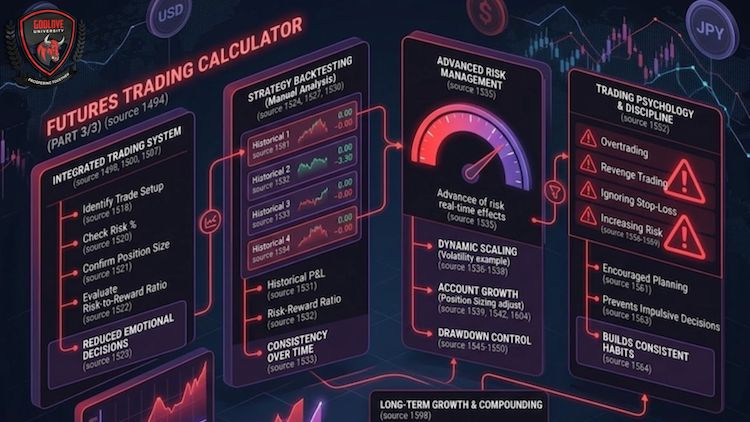
Before entering any trade, disciplined traders follow a process:
- Identify trade setup
- Input entry, exit, and stop-loss
- Check risk percentage
- Confirm position size
- Evaluate risk-to-reward ratio
Because of this structured approach, emotional decisions are reduced significantly.
Using the Calculator for Strategy Backtesting
What Is Backtesting?
Backtesting involves testing a trading strategy using historical data.
Although many platforms offer automated backtesting, a calculator can still play a role in manual analysis.
Applying the Calculator to Historical Trades
Traders can:
- Input past entry and exit points
- Calculate historical P&L
- Analyze risk-reward ratios
- Evaluate consistency over time
This process helps traders refine strategies before risking real capital.
Advanced Risk Management Techniques
Scaling Position Size Dynamically
Rather than using a fixed position size, advanced traders adjust based on:
- Market volatility
- Account growth
- Winning or losing streaks
For example:
- Increase size slightly after consistent profits
- Reduce size after consecutive losses
The calculator ensures adjustments remain within safe risk limits.
Maximum Drawdown Control
Drawdown refers to the decline in account balance during losing periods.
Using the calculator, traders can:
- Limit risk per trade
- Estimate worst-case scenarios
- Protect capital over time
Because of this, traders avoid catastrophic losses.
Trading Psychology and Discipline
Why Tools Alone Are Not Enough
Even the most advanced Futures Trading Calculator cannot prevent emotional mistakes.
Common psychological challenges include:
- Overtrading
- Revenge trading
- Ignoring stop-loss levels
- Increasing risk after losses
How the Calculator Reinforces Discipline
By forcing traders to define risk before entering a trade, the calculator:
- Encourages planning
- Prevents impulsive decisions
- Builds consistent habits
Over time, this discipline becomes second nature.
Automation and Efficiency
Reducing Human Error
Manual calculations increase the likelihood of mistakes.
However, the calculator automates:
- P&L calculations
- Risk percentages
- Position sizing
- Leverage metrics
As a result, traders can focus entirely on strategy.
Speed and Execution
Markets move quickly, especially in futures trading.
Because of this, fast decision-making is critical.
The calculator allows traders to:
- Instantly evaluate trades
- Enter positions confidently
- Avoid hesitation
Combining the Calculator with Trading Strategies
Trend Following + Calculator
Traders can:
- Identify trends
- Use calculator to confirm risk
- Optimize entry size
Breakout Trading + Calculator
Before entering a breakout:
- Measure potential reward
- Compare with stop-loss distance
- Confirm favorable ratio
Scalping + Calculator
Even short-term traders benefit from:
- Precise tick calculations
- Fast P&L projections
- Tight risk control
Long-Term Growth Using a Futures Trading Calculator
Compounding Gains
Consistent risk management allows traders to grow accounts steadily.
For example:
- Small gains accumulate over time
- Controlled losses preserve capital
- Account growth increases position size gradually
Tracking Performance Over Time
By combining the calculator with a trading journal, traders can:
- Monitor win rates
- Analyze risk-reward ratios
- Improve strategy performance
Common Advanced Mistakes to Avoid
Even experienced traders make mistakes.
Some of the most common include:
- Ignoring leverage exposure
- Over-optimizing trade setups
- Increasing risk too quickly
- Relying solely on the calculator without strategy
- Neglecting psychological discipline
Avoiding these pitfalls is essential for long-term success.
FAQs About Futures Trading Calculator
1. Can professionals benefit from a futures trading calculator?
Yes. Many professional traders rely on calculators for precision and efficiency.
2. Does using a calculator improve profitability?
It improves decision-making, which can lead to better long-term results.
3. How does the calculator help with discipline?
It forces traders to define risk and plan trades before execution.
4. Can I automate my trading using a calculator?
While calculators are not automated trading systems, they support structured decision-making.
5. Is it useful for small accounts?
Yes. It is especially important for small accounts where risk control is critical.
6. Should I use it for every trade?
Absolutely. Consistency is key to successful trading.
Conclusion: The Final Word on Futures Trading Calculator Mastery
Mastering a Futures Trading Calculator is not just about understanding numbers—it’s about building a disciplined, structured approach to trading.
Throughout this 3-part series, we explored:
- Basic calculator functions and setup
- Advanced risk and position sizing techniques
- Professional strategies and long-term optimization
Ultimately, the calculator serves as a bridge between strategy and execution. When used correctly, it transforms trading from guesswork into a calculated process.
However, success does not come from tools alone. Instead, it comes from combining discipline, consistency, and continuous improvement.
By integrating the calculator into a complete trading system, traders can navigate the futures markets with confidence, control risk effectively, and pursue sustainable long-term growth.
Useful Links
- Learn this and more with the Complete A to Z Forex & Futures Course
- Automate Your Trading with the Award Winning Patrex Pro Forex Bot