Futures Trading Calculator strategies explained. Learn advanced techniques for risk optimization, leverage control, and real-world trade scenarios using a futures trading calculator.
Introduction: Taking Your Futures Trading Calculator Skills to the Next Level
After learning the basics in Part 1, it becomes clear that a Futures Trading Calculator is more than just a simple tool—it’s a complete decision-making system. While beginners often use it to calculate profit and loss, experienced traders rely on it to refine strategies, control risk, and optimize performance.
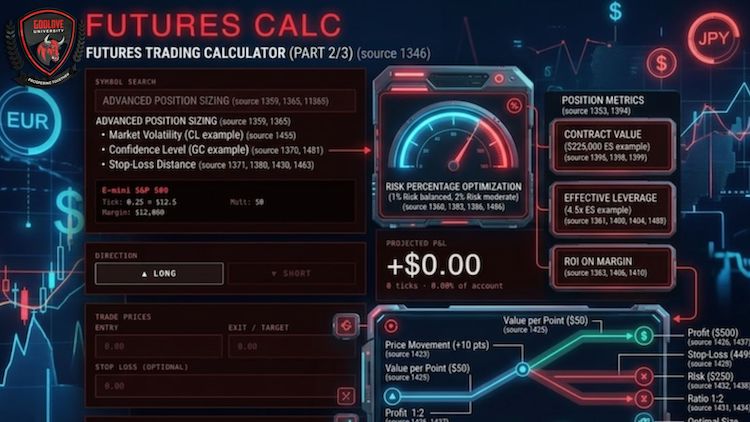
Looking again at the calculator interface from your image, several powerful features stand out:
- Projected P&L display
- Position metrics (contract value, leverage, ROI)
- Optimal sizing based on risk percentage
- Breakeven analysis tools
Although these features may seem advanced at first, understanding them can dramatically improve trading outcomes. Therefore, this article focuses on how to use these tools in real-world scenarios.
Specifically, we will explore:
- Advanced position sizing techniques
- Risk percentage optimization
- Leverage control strategies
- Real trade scenario walkthroughs
- Breakeven and ROI analysis
By mastering these elements, traders can move from basic calculations to strategic execution.
Advanced Position Sizing Techniques
Why Basic Position Sizing Isn’t Enough
Previously, we discussed the 1–2% risk rule. While this rule provides a solid foundation, advanced traders often refine their position sizing based on market conditions.
For example, traders may adjust position size depending on:
- Market volatility
- Trade confidence level
- Distance to stop-loss
- Economic events
As a result, position sizing becomes dynamic rather than fixed.
Using the Calculator for Precision Sizing
In the calculator image, the “Optimal Sizing (2% Risk)” feature automatically calculates the correct number of contracts.
For instance:
- Account balance: $50,000
- Risk: 2% → $1,000
- Result: 1 contract
However, if stop-loss distance increases, the calculator may suggest a smaller position size to maintain the same risk level.
This adjustment ensures that traders never exceed their predefined risk limits.
Risk Percentage Optimization
Choosing the Right Risk Level
Although 1–2% is commonly recommended, traders sometimes adjust risk based on experience.
Here’s a comparison:
Risk % | Impact |
0.5% | Very conservative |
1% | Balanced approach |
2% | Moderate growth |
3%+ | Aggressive, higher risk |
While higher risk may increase profits, it also increases the likelihood of large drawdowns.
How the Calculator Helps Control Risk
By entering a specific risk percentage, the calculator:
- Calculates maximum allowable loss
- Adjusts position size accordingly
- Displays percentage of account at risk
Because of this, traders can quickly evaluate whether a trade aligns with their risk tolerance.
Understanding Position Metrics
Contract Value
The calculator displays total contract value, which represents the full exposure of the trade.
For example:
- 1 ES contract ≈ $225,000 market exposure
Even though margin may only be $12,000, the actual exposure is much larger.
Effective Leverage
Leverage is calculated by comparing:
Contract Value ÷ Account Size
For example:
- $225,000 ÷ $50,000 = 4.5x leverage
The calculator displays this automatically, helping traders avoid excessive exposure.
ROI on Margin
Return on Investment (ROI) shows how much profit is generated relative to margin used.
This metric is especially useful because:
- Futures trading relies heavily on margin
- ROI helps compare trade efficiency
Real Trade Scenario Using the Futures Trading Calculator
Example Trade Setup
Let’s walk through a realistic scenario using the calculator:
- Market: ES (E-mini S&P 500)
- Direction: Long
- Entry: 4500
- Exit: 4510
- Stop-loss: 4495
- Contracts: 1
- Account: $50,000
- Risk: 2%
Step-by-Step Analysis
- Price Movement
- Entry to exit = +10 points
- Value per point = $50
- Profit = $500
- Risk Calculation
- Entry to stop-loss = 5 points
- Risk per point = $50
- Total risk = $250
- Risk-to-Reward Ratio
- Risk: $250
- Reward: $500
- Ratio = 1:2
What the Calculator Shows
The calculator instantly displays:
- Projected P&L: +$500
- Risk: $250 (0.5% of account)
- Leverage: Calculated automatically
- Optimal position size: Confirmed
Without this tool, calculating these values manually would be time-consuming.
Breakeven Analysis
What Is Breakeven?
Breakeven is the price at which a trade neither makes nor loses money.
The calculator includes a breakeven analysis section, which helps traders:
- Identify minimum required price movement
- Factor in trading costs
- Plan exit strategies
Why Breakeven Matters
Understanding breakeven allows traders to:
- Avoid premature exits
- Set realistic targets
- Manage expectations
Using the Calculator for Different Market Conditions
High Volatility Markets
During volatile conditions:
- Stop-loss distances increase
- Position size decreases
- Risk must be adjusted
The calculator helps traders quickly adapt.
Low Volatility Markets
In calmer markets:
- Smaller stop-loss distances
- Larger position sizes possible
- Tighter targets
Again, the calculator ensures accuracy.
Common Mistakes When Using a Futures Trading Calculator
Even with a powerful tool, traders can make mistakes.
Common errors include:
- Entering incorrect contract specifications
- Ignoring stop-loss inputs
- Using excessive leverage
- Overestimating profit potential
- Failing to adjust for volatility
Avoiding these mistakes improves trading consistency.
FAQs About Futures Trading Calculator
1. Can a futures calculator guarantee profits?
No. It only provides estimates and risk analysis.
2. How often should I use the calculator?
Before every trade to ensure proper planning.
3. Does the calculator work for all futures markets?
Yes, as long as contract specifications are included.
4. Can I use it for scalping?
Yes. It is useful for both short-term and long-term trading.
5. What is the most important metric to watch?
Risk percentage and position size are the most critical.
6. Is leverage dangerous in futures trading?
Yes, if not managed properly. The calculator helps control it.
Conclusion
A Futures Trading Calculator is not just a beginner tool—it is a professional-grade system for managing risk and optimizing trades. By using advanced features such as position metrics, leverage calculations, and breakeven analysis, traders can significantly improve their decision-making process.
As shown in your calculator interface, combining inputs like entry price, stop-loss, and risk percentage allows traders to evaluate trades with precision and confidence.
In Part 3, we will explore expert-level strategies, psychological discipline, and long-term trading optimization techniques, completing the journey toward mastering futures trading calculations.
Useful Links
- Learn this and more with the Complete A to Z Forex & Futures Course
- Automate Your Trading with the Award Winning Patrex Pro Forex Bot