
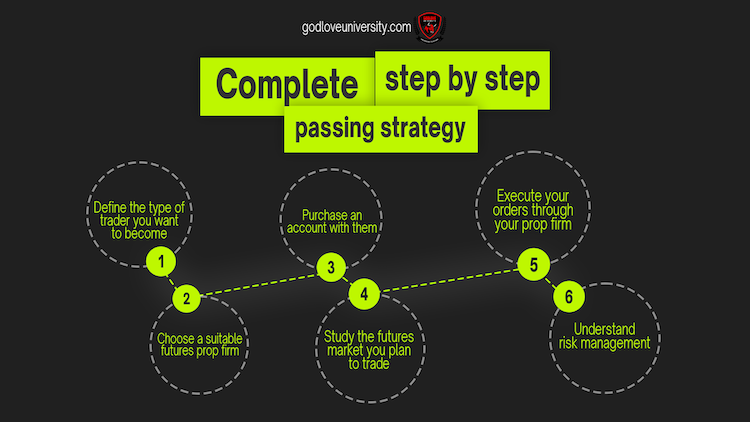
Master how to avoid failing a futures evaluation with a complete strategy; furthermore, learn how to manage drawdown, follow consistency rules, and pass with confidence.
Introduction
Now that you understand drawdown and consistency rules, the final step is putting everything together into a clear, repeatable plan. While many traders know the rules, they often fail because they lack structure.
Although passing an evaluation may seem difficult, it becomes much easier when you follow a disciplined system. Therefore, this article gives you a complete framework to pass consistently.
The Core Principle of Passing Evaluations
Before diving into steps, you need to understand one key idea:
You are not trying to make money — you are trying to pass the rules.
Because of this:
- Risk management becomes your priority
- Consistency becomes your strategy
- Profit becomes a byproduct
Step 1: Choose the Right Evaluation Type
Not all evaluations are equal. Therefore, selecting the right one improves your chances significantly.
Comparison:
Type | Advantage | Challenge |
Static Drawdown | Easier to manage | Less flexibility |
Trailing Drawdown | More scaling potential | Higher difficulty |
Recommendation:
- Beginners → Start with static drawdown
- Experienced traders → Consider trailing
Step 2: Set Your Risk Parameters
Once you start, define strict risk rules immediately.
Ideal Risk Structure:
Metric | Rule |
Risk per trade | 0.5% – 1% |
Max daily loss | 2% |
Max trades per day | 2–5 |
Why This Works:
- Protects drawdown
- Maintains consistency
- Prevents emotional decisions
Step 3: Create a Daily Profit Target
Instead of chasing the full target, break it down.
Example:
Total Target | Daily Goal |
$3,000 | $200–$400 |
Key Insight:
Slow and steady growth is more reliable.
Step 4: Trade Only High-Quality Setups
Not every opportunity is worth taking. Therefore, you must filter aggressively.
Trade Selection Rules:
Rule | Purpose |
Trade with trend | Higher probability |
Wait for confirmation | Avoid false entries |
Avoid news volatility | Reduce risk |
Step 5: Control Your Trading Days
Consistency rules often require multiple trading days. Because of this, pacing is critical.
Example Plan:
Day | Target |
Day 1 | $300 |
Day 2 | $250 |
Day 3 | $350 |
Day 4 | $200 |
Day 5 | $300 |
Result:
- Smooth equity curve
- No rule violations
Step 6: Protect Profits (Especially with Trailing Drawdown)
As your account grows, your margin for error shrinks.
Practical Rules:
Situation | Action |
Hit daily target | Stop trading |
In profit | Tighten risk |
Near drawdown limit | Reduce position size |
Key Insight:
Protecting profits is more important than increasing them.
Step 7: Avoid the Final Stage Mistake
Many traders fail near the profit target because they rush.
Common Scenario:
Stage | Behavior | Outcome |
Near target | Increase lot size | ❌ Fail |
Disciplined | Maintain strategy | ✅ Pass |
Rule:
Trade the same way at the end as you did at the start.
Complete Evaluation Blueprint
Here’s a simple system you can follow:
Daily Framework:
Step | Action |
1 | Analyze market direction |
2 | Identify key levels |
3 | Wait for setup |
4 | Execute with fixed risk |
5 | Stop after target is hit |
Example Passing Strategy (Putting It All Together)
Metric | Value |
Account Size | $50,000 |
Risk per trade | 0.5% |
Daily target | $200–$400 |
Trades per day | 2–4 |
Evaluation duration | 7–10 days |
Outcome:
- Meets consistency rules
- Avoids drawdown breaches
- Reaches target safely
Common Final Mistakes to Avoid
Even at this stage, traders still fail due to:
❌ Overconfidence after early profits
❌ Increasing lot size near the target
❌ Ignoring rules to “finish faster”
❌ Trading emotionally after losses
However, discipline eliminates these risks.
Key Takeaways
- Focus on passing rules, not making money
- Use low, consistent risk per trade
- Break profit targets into smaller goals
- Protect profits, especially with trailing drawdown
- Stay consistent from start to finish
Final Thought
Passing a futures evaluation is not about being the best trader—it’s about being the most disciplined. While many traders chase profits, successful traders focus on control, structure, and consistency.
Ultimately, if you follow a repeatable system and respect the rules, passing becomes predictable rather than uncertain.
Series Summary
Article 1:
- Static vs trailing drawdown explained
Article 2:
- Consistency rules and execution
Article 3:
- Complete step-by-step passing strategy
If applied correctly, this framework will not only help you pass evaluations, but also prepare you for long-term success as a funded trader.
Useful Links
- Learn this and more with the Complete A to Z Forex & Futures Course
- Automate Your Trading with the Award Winning Patrex Pro Forex Bot