
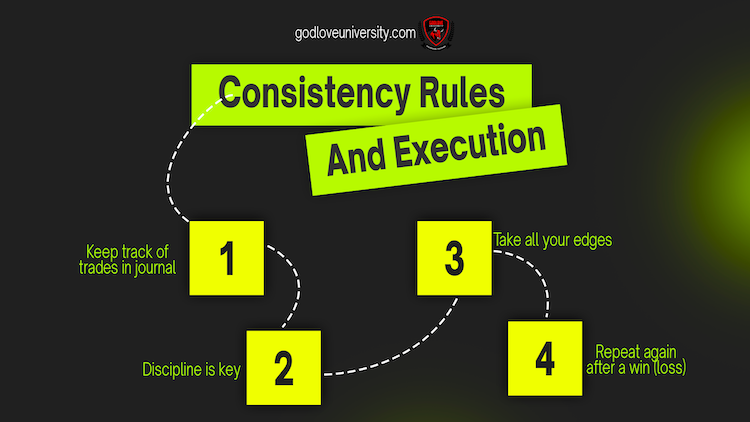
Learn how to avoid failing a futures evaluation by mastering consistency rules; furthermore, understand how to structure trades, while managing risk, and maintaining stable performance.
Introduction
Now that you understand drawdown, the next step is mastering consistency rules. While many traders protect their accounts initially, they often fail because their performance is too uneven.
Although hitting the profit target is important, prop firms prioritize how you reach that target. Therefore, even profitable traders can fail if they violate consistency requirements.
In this article, we break down how to trade consistently, structure your trades properly, and avoid common rule violations.
What Are Futures Prop Firm Consistency Rules?
Consistency rules are designed to prevent traders from passing evaluations through one large trade or risky behavior.
Core Idea:
Your profits must be evenly distributed, not concentrated.
Common Types of Consistency Rules
Although rules vary by firm, most follow similar structures.
1. Daily Profit Limit Rule
This rule restricts how much profit can come from a single day.
Example | Rule |
Total Profit Target | $3,000 |
Max Daily Contribution | 40% ($1,200) |
If you make too much in one day, the excess may not count.
2. Single Trade Dominance Rule
This prevents one trade from accounting for most of your profits.
Scenario | Result |
One trade = 70% of profits | ❌ Violation |
Multiple trades contributing | ✅ Acceptable |
3. Minimum Trading Days Rule
Most firms require a minimum number of trading days.
Requirement | Example |
Minimum days | 5–10 days |
Goal | Prevent quick “lucky” passes |
Why Traders Fail Consistency Rules
Even skilled traders fail because they don’t adapt their approach.
Common Mistakes:
Mistake | Outcome |
One big winning trade | Fails consistency check |
Inconsistent lot sizes | Irregular performance |
Overtrading after wins | Drawdown risk |
Rushing to hit target | Rule violations |
How to Structure Trades for Consistency
To pass an evaluation, your trading must look controlled and repeatable.
Step 1: Standardize Your Risk
Instead of changing lot sizes randomly, use fixed risk per trade.
Account Size | Risk Per Trade |
$50,000 | 0.5% – 1% |
$100,000 | 0.5% – 1% |
Result:
- Stable equity curve
- Predictable outcomes
Step 2: Control Daily Profit Targets
Rather than aiming for large wins, aim for consistent daily gains.
Day | Profit Target |
Day 1 | $300 |
Day 2 | $250 |
Day 3 | $350 |
Key Insight:
Small, repeated wins are better than one large gain.
Step 3: Limit Trade Frequency
Although trading more may seem beneficial, fewer high-quality trades improve consistency.
Approach | Result |
10+ trades/day | Inconsistent |
2–5 trades/day | Controlled |
Step 4: Avoid “All-in” Trades
Large trades may hit targets quickly; however, they often violate rules.
Behavior | Outcome |
Large position size | High risk |
Small consistent trades | Stable growth |
Building a Consistent Equity Curve
Prop firms look for smooth growth rather than volatility.
Example Comparison:
Type | Equity Curve |
Inconsistent Trader | Big spikes and drops |
Consistent Trader | Gradual upward growth |
Combining Drawdown + Consistency Rules
To succeed, you must manage both simultaneously.
Rule Type | Focus |
Drawdown | Protect losses |
Consistency | Control profits |
Key Balance:
- Too aggressive → fail consistency
- Too slow → struggle to hit target
Practical Daily Trading Plan
Use this structure to stay within rules:
Daily Checklist:
Step | Action |
1 | Set daily profit limit |
2 | Define max risk per trade |
3 | Take 2–5 quality trades |
4 | Stop after hitting target |
5 | Avoid overtrading |
Example Evaluation Strategy
Here’s a simple approach for a $50K account:
Metric | Strategy |
Risk per trade | 0.5% |
Daily target | $200–$400 |
Trades per day | 2–4 |
Trading days | 7–10 |
Key Takeaways
- Consistency rules prevent “lucky” passes
- Avoid relying on one big trade
- Standardize your risk and trade size
- Focus on small, repeatable profits
- Build a smooth and stable equity curve
What’s Next (Article 3/3)
In the final article, we’ll cover:
- A complete step-by-step plan to pass any futures evaluation
- Advanced tips to avoid hidden pitfalls
- How to transition from evaluation to funded trader
This is where you move from consistency… to passing with confidence.
Useful Links
- Learn this and more with the Complete A to Z Forex & Futures Course
- Automate Your Trading with the Award Winning Patrex Pro Forex Bot