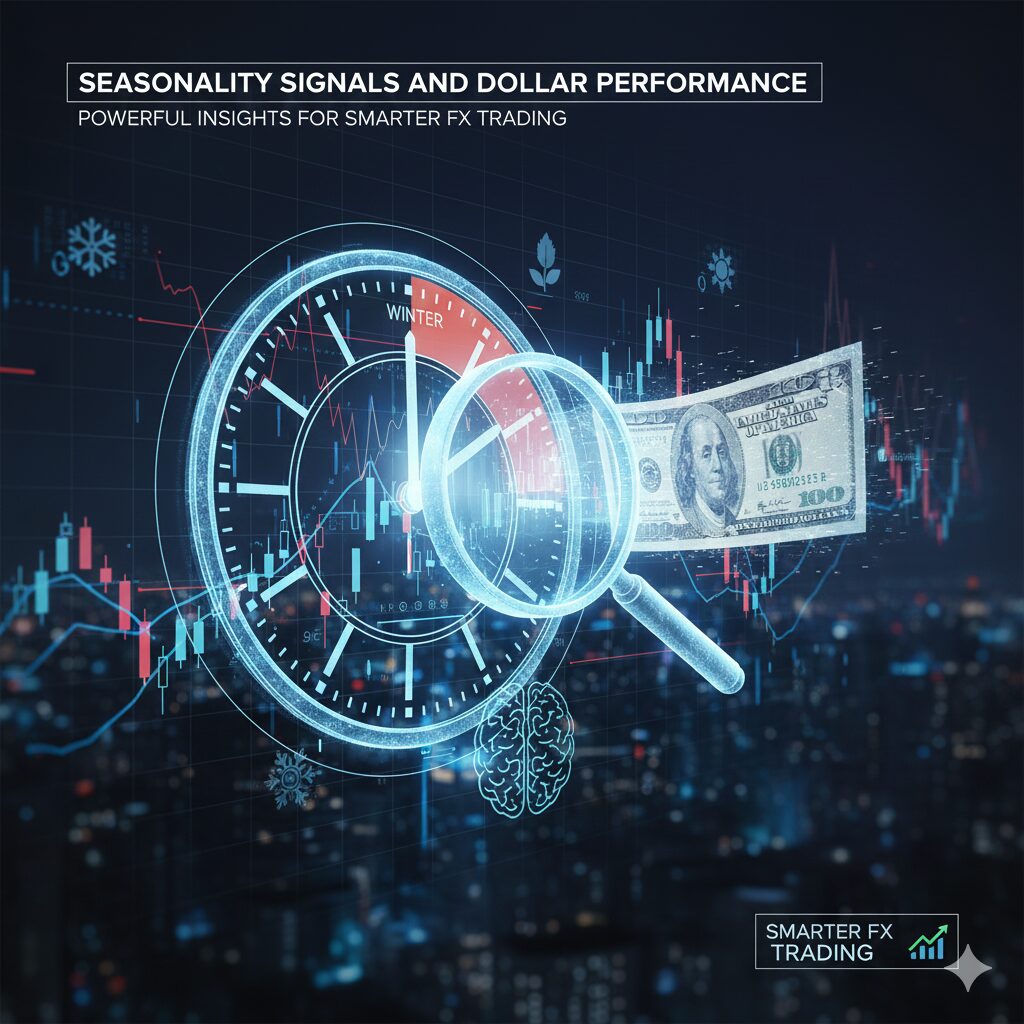
Seasonality Signals and Dollar Performance form one of the most fascinating and actionable intersections in currency markets. Every year, the FX landscape reveals recurring patterns shaped not by chance, but by consistent trader behavior, institutional rebalancing, and structural market forces. While short-term volatility often clouds judgment, stepping back to view the larger seasonal cycles allows traders to identify patterns that have persisted across decades. December, in particular, stands out as a month where these patterns intensify, giving market participants a reliable roadmap of what to expect as conditions change and liquidity thins.
The phrase Seasonality Signals and Dollar Performance captures far more than a statistical tendency. It represents a framework—one that blends market psychology, institutional flows, and macro conditions into a predictable structure. Understanding these signals empowers traders to anticipate shifts, refine their strategies, and gain confidence during periods when markets otherwise appear quieter and more uncertain. In this article, we explore how these patterns form, why they repeat, and how traders can use them to make better decisions in the FX arena.
Seasonality Signals and Dollar Performance
The concept of Seasonality Signals and Dollar Performance rests on the principle that markets, despite seeming unpredictable, often exhibit stable long-term rhythms. In the case of the U.S. dollar, decades of data demonstrate a remarkably consistent seasonal bias, particularly in December. The dollar’s December win rate sits below 34%, meaning it loses value nearly two-thirds of the time. Not only is this frequency notable, but the magnitude is equally compelling: when the dollar weakens in December, it typically does so with an average monthly drop of around 2.2%.
The alignment of both average and median returns reinforces that the pattern is not distorted by isolated events or outliers. Instead, it represents a stable seasonal signal shaped by market structure and recurring behavior. These conditions make the theme of Seasonality Signals and Dollar Performance especially relevant for traders who rely on statistical probability and consistent patterns to guide execution.
Why Seasonality Signals and Dollar Performance Matter
Seasonality provides a unique compass in markets often overwhelmed by noise. When traders observe that certain patterns persist over long stretches, they gain insight into how institutional habits, calendar effects, and global capital flows shape price behavior.
Seasonality signals matter because:
- They reflect real, repeated actions by major market participants
- They create predictable windows of opportunity
- They reduce reliance on speculation and guesswork
- They highlight asymmetries in risk and reward
- They help traders anticipate liquidity drops and flow changes
By integrating seasonality into their frameworks, traders turn a chaotic market into something more structured and navigable.
How Seasonal Cycles Define Dollar Trends
The dollar’s behavior across the year follows a rough cycle driven by global trade flows, investment cycles, central bank actions, and risk sentiment. December plays a special role in this cycle. As the final month of the year, it brings a culmination of hedging, closing of books, tax considerations, and realignment of positions.
These pressures tend to converge in a way that systematically weakens the dollar, giving rise to predictable downward trends. While macroeconomic factors certainly influence monthly direction, the end-of-year cycle has proven powerful enough to override even strong bullish sentiment on occasion.
Long-Term Datasets Revealing Predictable Behavior
Reliable seasonality requires large datasets—spanning decades—to confirm that patterns persist. In this case, the signals are clear: Seasonality Signals and Dollar Performance show repeated December softness. When average and median returns align, the implication is stability rather than coincidence.
This alignment indicates:
- Limited distortion from extreme years
- No heavy skew effect
- A stable distribution
- A real behavioral cycle, not noise
This is why seasoned FX traders pay close attention to December’s structure and outcomes.
Why Return Alignment Strengthens Seasonality Signals
Average returns can be misleading because large outliers distort the data. But when average and median returns fall in the same range, it becomes much harder to dismiss the signal. This suggests that most years—not just a few—participate in the trend.
Return alignment confirms that:
- Down years for the dollar are common
- The size of the losses is consistent
- The seasonal bias is strong enough to be statistically significant
This is a rare combination in financial time series, making the seasonality exceptionally noteworthy.
Dollar’s Historically Low December Win Rate
A win rate below 34% indicates that the dollar struggles far more often than it succeeds in December. Unlike other monthly biases, which might show slimmer margins, this lopsided ratio signals a powerful and reliable tendency.
This lopsidedness is explained by multiple converging pressures:
- Position unwinding
- Year-end corporate flows
- Deleveraging
- Risk-on sentiment
- Thin liquidity amplifying moves
These factors collectively drive the win rate down and reinforce the structure of seasonal dollar softness.
Why Losses Cluster in Specific December Windows
Not all December days carry the same influence. Historical analysis reveals a notable clustering effect in the final 10 trading days of the month. This micro-seasonality becomes essential for tactical traders who seek to enter trades with optimal timing.
The clustering happens because:
- Portfolio rebalancing peaks late in the month
- Liquidity sharply declines
- Hedge adjustments complete
- Funds reduce USD exposure ahead of year close
This cluster transforms a month-long bias into a short window of heightened predictability.
Market Psychology Shaping Dollar Performance
Seasonality is inseparable from psychology. The holiday period brings a shift in sentiment, with traders becoming more conservative about initiating new positions while being more aggressive about locking in gains. This duality weakens the dollar because USD positions are typically large and widely held, making them prime candidates for year-end trimming.
Additionally, risk sentiment often improves into year-end, putting downward pressure on safe-haven currencies like USD.
How Year-End Position Flows Impact Seasonality
Institutional investors, asset managers, and corporate treasuries all adjust their portfolios and exposures at year-end. A considerable portion of global portfolios has USD exposure, and these hedging and rebalancing decisions often require selling USD.
This synchronized behavior forms the backbone of December seasonality.
Low Liquidity Reinforcing Seasonal Tendencies
Liquidity declines sharply in December, especially after mid-month. In thin markets, even moderate flows create outsized price movements. When the directional bias is already downward, low liquidity amplifies the drop—intensifying Seasonality Signals and Dollar Performance.
Fund Rebalancing and USD Selling Pressure
Large funds reduce USD holdings to rebalance currency weights before closing the fiscal year. This process is systematic, predictable, and widespread—making it a staple driver of December dollar weakness.
Risk-On Sentiment and Its Seasonal Effect on USD
Historically, December is a strong month for equities. This risk-on environment naturally weakens the dollar, which behaves as a safe-haven asset.
Safe Havens Behave Differently in December
Interestingly, while USD weakens, other safe-havens like CHF or JPY may strengthen due to profit-taking and regional flow dynamics. This highlights the importance of understanding nuanced seasonal behavior within FX markets.
Currencies Benefiting from Seasonal Dollar Weakness
Pairs such as:
- USDCHF
- EURUSD
- NZDUSD
tend to outperform. Each performs differently based on underlying regional flows.
Swiss Franc’s Reaction to Seasonality Signals
CHF often rises due to safe-haven demand and European year-end flow adjustments.
Seasonal Strength in EURUSD
EURUSD tends to show consistent December gains supported by corporate repatriation flows and cooling political risk.
NZDUSD’s High Win Rate and December Performance
NZDUSD features a win rate of ~66%, making it one of the most reliable seasonal performers.
Volatility Compression and Dollar Movements
December often brings lower volatility, which ironically makes directional moves more consistent. This benefits pattern recognition and trend-following strategies.
Micro-Seasonality in the Final 10 Days
The last 10 days capture most of the movement. Traders monitor this window closely.
Market Rhythm Traders Often Overlook
The rhythm of the market becomes steadier, allowing seasonal tendencies to appear more clearly.
Using Seasonality Signals and Dollar Performance in Trading
Traders can:
- Time entries around seasonal clusters
- Reduce risk by aligning with proven tendencies
- Pair seasonality with momentum indicators for accuracy
Strategies for Applying Seasonality Signals and Dollar Performance
Some effective methods include:
- Buy EURUSD late-month dips
- Short USDCHF into low-liquidity flows
- Build NZDUSD positions ahead of the final 10-day cluster
Pitfalls to Avoid
Avoid assuming seasonality guarantees outcomes. It guides probability—not certainty.
Technical Analysis Tools to Confirm Seasonality Signals
Use:
- Moving Averages (20/50/100/200 SMA/EMA)
Identify whether the USD is trending lower into December and confirm momentum alignment with seasonal bias. - MACD (Moving Average Convergence Divergence)
Helps validate whether bearish momentum is increasing during the seasonal weakness window. - RSI (Relative Strength Index)
Shows whether the dollar is entering sustained overbought → neutral → oversold cycles typical in late-December selloffs. - Commodity Channel Index (CCI)
Detects cyclical turning points and can highlight when USD momentum shifts match historical seasonal reversals. - Bollinger Bands
Useful for spotting volatility compressions followed by directional breaks that often occur in thin December liquidity. - Volume & Volatility Indicators (ATR / Tick Volume)
Confirm whether thin end-month liquidity is amplifying price moves aligned with seasonal expectations.
December Seasonal Behavior
Examples across decades reveal:
- Recurring EURUSD gains
- Consistent USDCHF weakness
- Strong NZDUSD seasonality regardless of macro backdrop
FAQs
What causes seasonal patterns in the dollar?
Flows, liquidity, psychology, and institutional adjustments.
Is seasonality reliable for trading?
It improves probabilities but should complement other signals.
Why is December significant?
Year-end flows intensify predictable pressure on USD.
Which currencies benefit most?
CHF, EUR, and NZD consistently outperform.
Does low liquidity help or hurt?
It magnifies existing directional tendencies.
Can seasonality override macro trends?
Sometimes, especially when institutional flows dominate.
Conclusion
Seasonality provides one of the most structured ways to interpret FX market behavior. When traders understand Seasonality Signals and Dollar Performance, they can anticipate late-year shifts with greater confidence. December’s predictable pattern—marked by a weak dollar, strong FX majors, and compressed volatility—creates opportunities for those who integrate seasonality into their analytical process. By blending data, psychology, and market structure, traders gain an edge that transforms year-end uncertainty into strategic clarity.
In our final article of this series, we provide more detailed forecasts of specific Forex pairs that may provide even more insight for trading in December.
Useful Links:
- Ready for Part 3 – the Final & Most Valuable Article on December Trading Strategies? – Read the Article Here.
- Ready to learn even more Winning Strategies? Read more about our Forex Course here.
- Why not Automate your Strategy – while on Holiday? Learn more about Patrex Pro – our Award Winning Forex Bot.