Is Futures Trading Safer Than Forex? Discover expert insights, institutional preferences, transparency advantages, and long-term profitability comparisons between futures and forex markets.
Introduction: The Final Verdict on Is Futures Trading Safer Than Forex
Throughout this series, one central question has guided the discussion: Is Futures Trading Safer Than Forex? Earlier articles examined market structure, regulation, leverage mechanics, margin requirements, and volatility exposure. Now, in this final installment, attention shifts toward professional trading environments, institutional participation, transparency advantages, and long-term sustainability.
At first glance, both markets provide substantial opportunities for traders seeking to profit from price movements. Nevertheless, professionals often choose their markets carefully based on structural advantages rather than convenience alone.
Forex trading remains incredibly accessible. Indeed, almost anyone with an internet connection can open an account and begin trading currencies. Conversely, futures markets typically require slightly higher capital and a stronger understanding of contract mechanics.
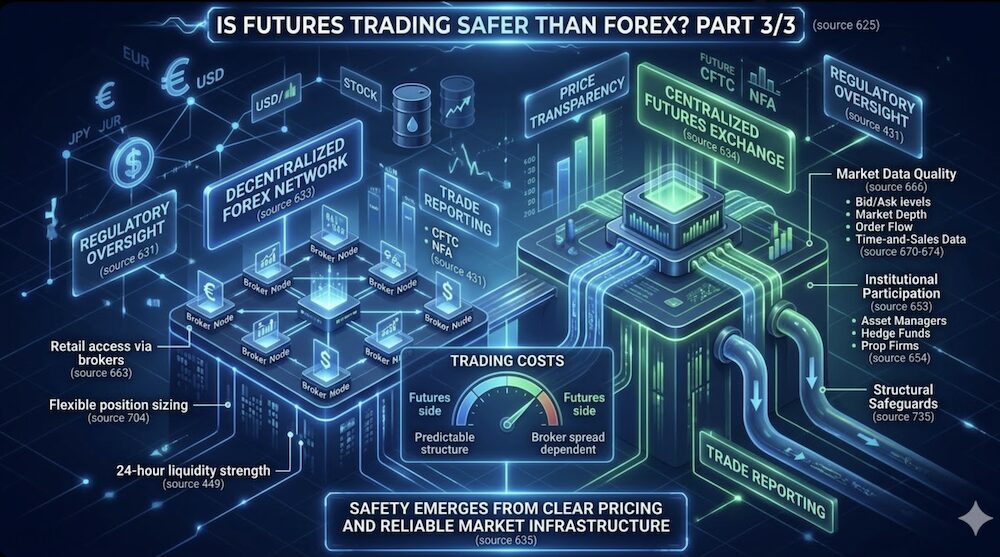
However, accessibility does not always equal safety. Instead, safety emerges from clear pricing, consistent regulation, fair execution, and reliable market infrastructure.
Consequently, evaluating whether futures trading offers a safer environment requires examining several additional factors:
- Institutional participation
- Market transparency
- Data reliability
- Trading costs
- Long-term sustainability for traders
By analyzing these aspects carefully, traders can form a balanced conclusion about which market environment better supports disciplined trading over time.
Institutional Participation in Futures and Forex
Why Institutional Traders Influence Market Stability
Large financial institutions play a critical role in shaping market stability. Banks, hedge funds, pension funds, and professional trading firms contribute enormous liquidity and help maintain efficient price discovery.
Because institutions manage vast amounts of capital, they typically favor markets that provide:
- Transparent pricing
- Reliable execution
- Strong regulatory oversight
- Deep liquidity
For these reasons, institutional participation often reveals which markets professionals trust the most.
Institutional Activity in Futures Markets
Futures markets attract extensive institutional participation. Major asset managers, hedge funds, and proprietary trading firms frequently trade futures contracts for hedging and speculation.
For example, contracts traded on the
Chicago Mercantile Exchange
represent some of the most liquid financial instruments in the world.
Institutions rely on futures markets to hedge exposure to:
- Stock indices
- Interest rates
- Commodities
- Foreign currencies
Because these markets support enormous institutional flows, liquidity remains robust and pricing tends to remain highly efficient.
Institutional Role in Forex Markets
Banks dominate the global forex market. However, retail forex trading often occurs through broker platforms rather than direct interbank participation.
Although large institutions trade currencies heavily, retail traders interact mainly with brokers instead of directly with the interbank market.
Therefore, retail traders operate in a different environment than institutional forex participants, which sometimes creates disparities in pricing and execution quality.
Transparency and Market Data Quality
Futures Market Transparency
Transparency represents one of the strongest arguments supporting futures trading.
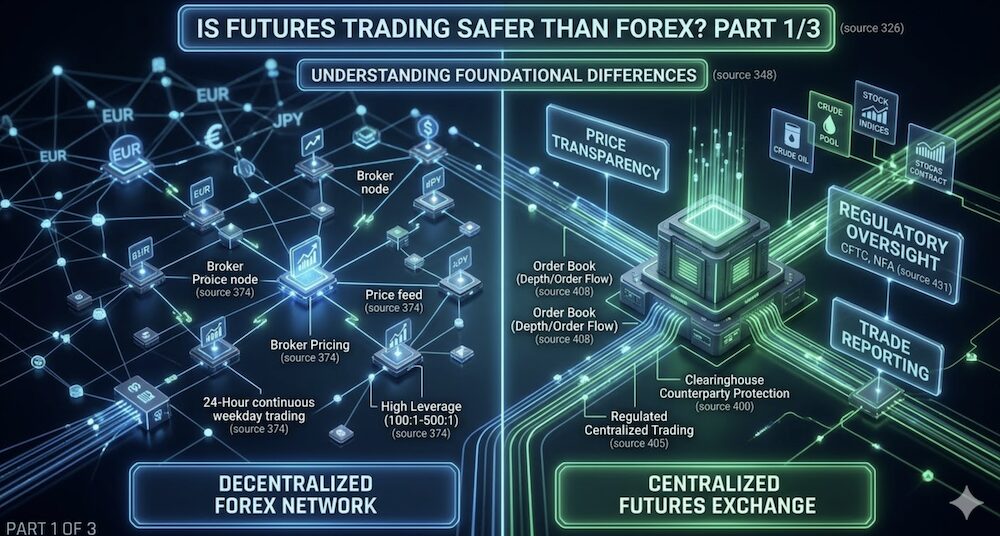
Every transaction on futures exchanges becomes part of the public order book. Consequently, traders gain access to valuable information such as:
- Bid and ask levels
- Market depth
- Order flow activity
- Time-and-sales data
Because all participants see identical data, futures markets promote a level playing field.
Additionally, centralized exchanges maintain historical price records, ensuring reliable data for analysis and backtesting.
Forex Data Limitations
Forex markets operate differently. Since forex transactions occur through decentralized networks, no single source provides complete market data.
Retail traders usually rely on data feeds from their brokers. While these feeds often remain accurate, they may not reflect the entire global forex market.
Consequently, chart patterns and price levels may vary slightly between brokers.
Although these differences are usually small, they can affect certain trading strategies, particularly those relying on precise technical levels.
Trading Costs and Spreads
Forex Cost Structure
Forex brokers typically earn revenue through spreads or commissions.
For major currency pairs, spreads often remain extremely tight, sometimes less than one pip.
Nevertheless, spreads may widen significantly during:
- Economic announcements
- Low-liquidity sessions
- Unexpected market events
Additionally, some brokers add markups to spreads depending on account types.
Futures Trading Costs
Futures trading costs generally include:
- Exchange fees
- Clearing fees
- Broker commissions
Because futures markets operate on centralized exchanges, spreads reflect true market supply and demand rather than broker pricing decisions.
Although commission costs exist, many traders appreciate the predictable cost structure.
Strategy Flexibility and Market Access
Forex Trading Advantages
Forex trading offers several unique benefits:
- 24-hour weekday trading
- Extremely high liquidity
- Small position sizes for beginners
- Wide availability of brokers
These features make forex particularly attractive to traders with limited starting capital.
Furthermore, currency markets often display smooth price movements compared with some highly volatile futures contracts.
Futures Trading Advantages
Futures trading provides different strengths.
Because futures contracts represent diverse asset classes, traders can access markets including:
- Stock indices
- Agricultural commodities
- Energy markets
- Interest rates
- Metals
Moreover, many exchanges now offer micro futures contracts, allowing traders with smaller accounts to participate.
This expansion has significantly increased accessibility to futures markets in recent years.
Long-Term Sustainability for Traders
The Challenge of Retail Trading
Regardless of market choice, retail trading presents substantial challenges.
Common obstacles include:
- Overleveraging
- Emotional decision-making
- Lack of trading plans
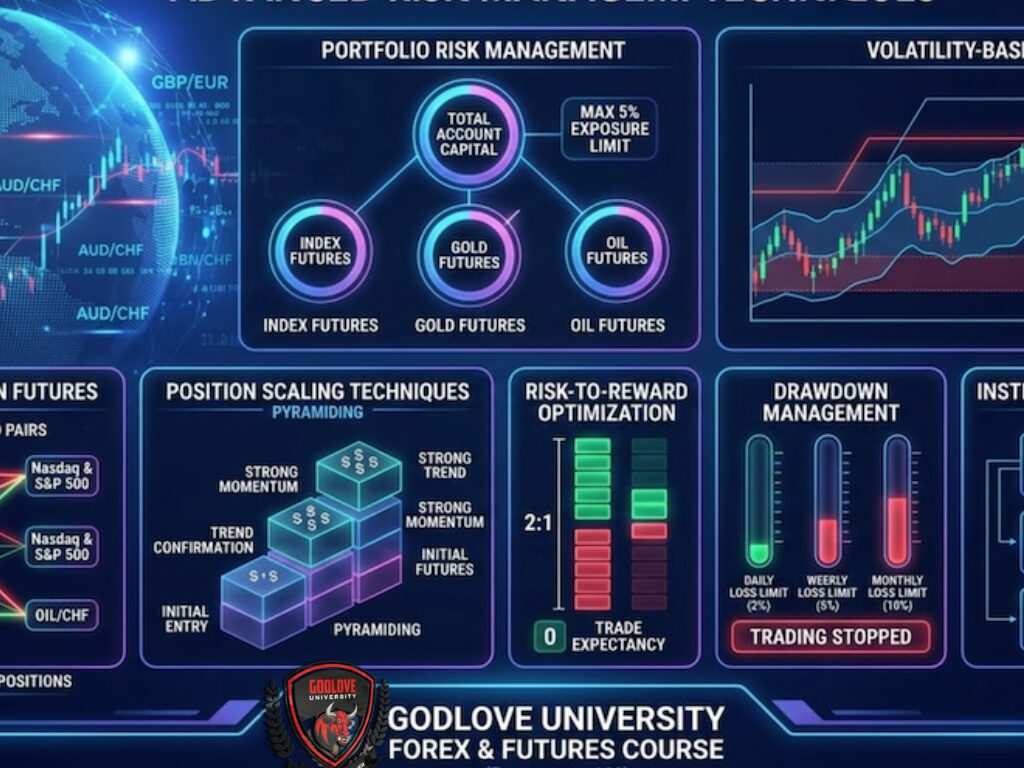
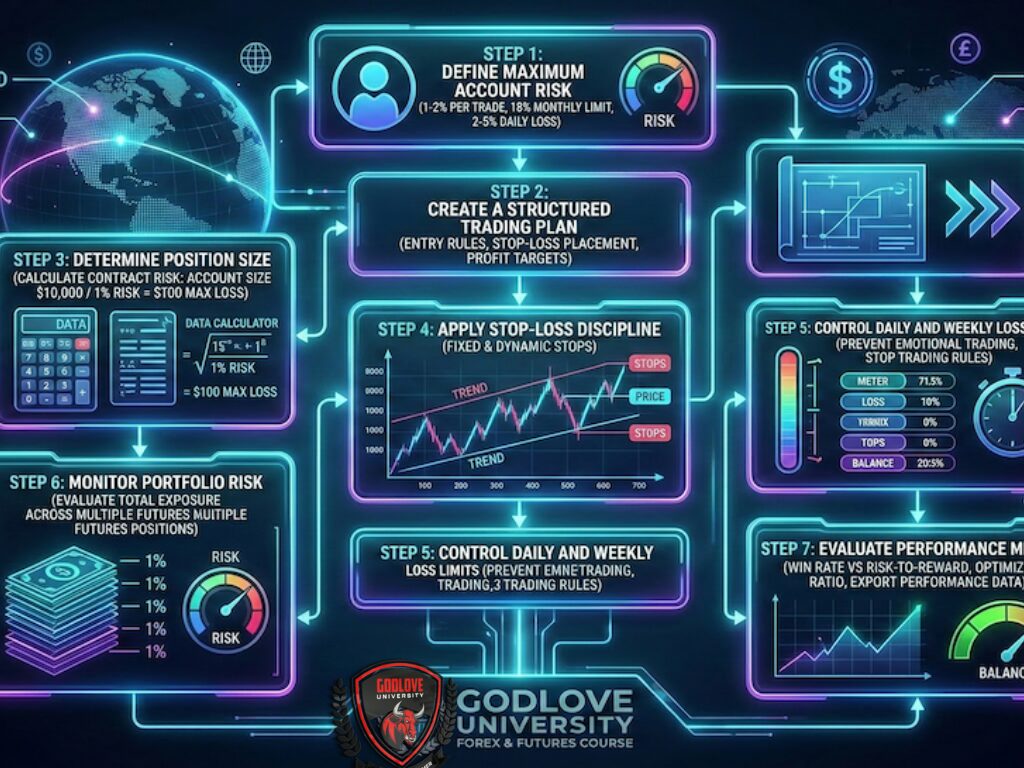
- Poor risk management
Therefore, long-term success depends less on the market itself and more on trader discipline.
Why Many Professionals Prefer Futures
Despite these challenges, many experienced traders prefer futures markets for several reasons.
Firstly, centralized exchanges create transparent trading environments. Secondly, standardized contracts simplify strategy development. Thirdly, reliable historical data supports accurate backtesting.
Additionally, strict regulation provides confidence that market rules remain consistent.
For these reasons, professional traders frequently gravitate toward futures trading for systematic strategies.
Final Comparison: Futures vs Forex Safety
The following table summarizes the most important safety factors.
Factor | Forex Market | Futures Market |
Market structure | Decentralized | Centralized exchange |
Price transparency | Broker dependent | Fully transparent order book |
Regulation | Varies by broker | Strict exchange regulation |
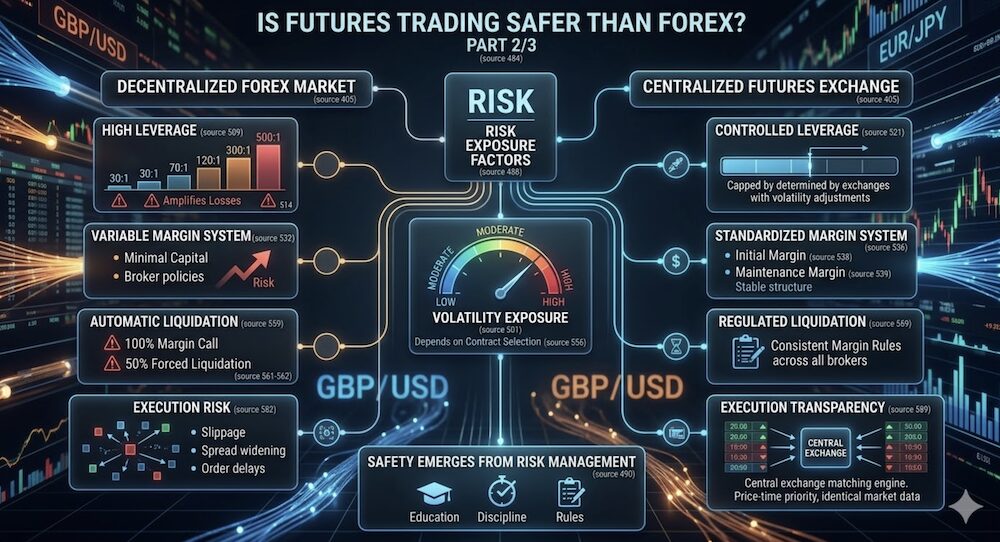
Leverage availability | Very high | Moderately controlled |
Institutional participation | Interbank level | Extensive institutional trading |
Data reliability | Broker feed | Centralized market data |
Although both markets provide opportunities, futures trading tends to offer stronger structural safeguards.
FAQs About Is Futures Trading Safer Than Forex
1. Why do many professionals prefer futures trading?
Professionals often prefer futures because centralized exchanges provide transparent pricing, consistent regulations, and reliable market data.
2. Can beginners succeed in forex trading?
Yes. Beginners can succeed if they use regulated brokers, limit leverage, and apply strict risk management strategies.
3. Do futures markets eliminate trading risk?
No market eliminates risk entirely. Futures trading still involves leverage, volatility, and potential losses.
4. Which market has better price transparency?
Futures markets generally offer better transparency because all orders appear on centralized exchange order books.
5. Is forex trading manipulated?
While major currency markets remain highly competitive, certain broker practices can influence spreads or execution quality.
6. Should traders choose futures instead of forex?
The best choice depends on trading style, capital, risk tolerance, and market knowledge.
Conclusion: The Final Answer to Is Futures Trading Safer Than Forex
After examining market structure, leverage mechanics, transparency, and institutional participation, the question Is Futures Trading Safer Than Forex becomes easier to answer.
Futures markets generally provide stronger structural protections through centralized exchanges, standardized contracts, and strict regulatory oversight. Because of these features, many professional traders consider futures markets more transparent and reliable.
However, forex trading still offers significant advantages, including unmatched liquidity, global accessibility, and flexible position sizing.
Ultimately, the safest trading environment depends not only on the market itself but also on the trader’s discipline, education, and risk management practices.
A well-informed trader can succeed in either market. Nevertheless, understanding the structural differences between futures and forex empowers traders to choose the environment that best aligns with their strategy and long-term goals.
Useful Links
- Learn this and more with the Complete A to Z Forex & Futures Course
- Automate Your Trading with the Award Winning Patrex Pro Forex Bot