Is Futures Trading Safer Than Forex? Discover the key safety differences, regulation structures, and risk factors traders must understand before choosing between futures and forex markets.
Introduction: Understanding the Debate Around Is Futures Trading Safer Than Forex
Financial markets offer countless opportunities for traders. Nevertheless, choosing the right market often determines whether a trader succeeds or struggles. Among the most debated questions in trading communities is Is Futures Trading Safer Than Forex?
At first glance, both markets appear similar. Each one allows speculation on price movements without owning the underlying asset. Furthermore, both markets offer leverage, enabling traders to control larger positions with smaller capital. However, beneath the surface, the structure, regulation, transparency, and risk profiles differ significantly.
Consequently, many beginners assume that all leveraged markets carry identical risk levels. Yet experienced traders recognize that market mechanics matter enormously. Liquidity, regulation, centralized exchanges, and pricing transparency all influence the safety of a trading environment.
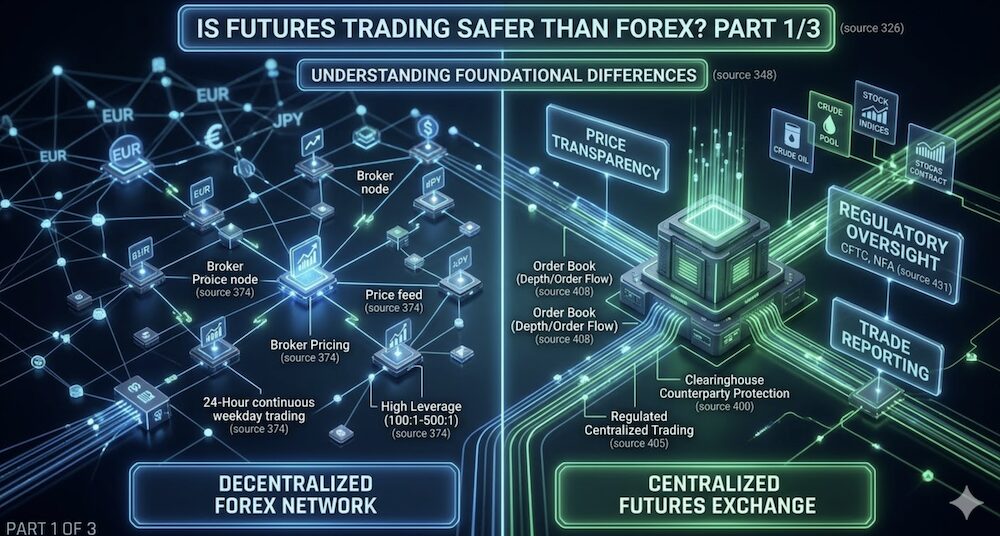
Interestingly, futures trading operates primarily through centralized exchanges. Forex trading, on the other hand, mostly occurs in decentralized over-the-counter markets. Because of this fundamental difference, risk exposure, broker practices, and price consistency vary considerably.
Moreover, traders frequently misunderstand the concept of “safety.” Safety in trading does not mean eliminating risk entirely. Instead, it refers to structural protections, transparency, and reduced chances of manipulation or unfair execution.
Therefore, evaluating whether futures trading is safer requires examining several factors:
- Market structure
- Regulatory oversight
- Price transparency
- Liquidity conditions
- Counterparty risk
- Broker influence
Throughout this three-part series, each of these components will be explored carefully. First, this article will focus on the foundational differences between futures and forex markets. Subsequently, the next parts will analyze risk exposure and trader protections in greater depth.
Ultimately, understanding these distinctions allows traders to choose a market aligned with their experience level, strategy, and risk tolerance.
What Is Forex Trading?
Overview of the Global Forex Market
Forex, short for foreign exchange, represents the largest financial market in the world. Every day, trillions of dollars exchange hands as participants trade currency pairs.
Unlike stock or futures markets, forex does not operate through a single centralized exchange. Instead, banks, financial institutions, hedge funds, and brokers form a decentralized network where currencies trade continuously.
As a result, forex trading operates 24 hours a day during weekdays, spanning major financial centers including:
- London
- New York
- Tokyo
- Sydney
Because of this global structure, forex provides extraordinary liquidity and accessibility for traders.
How Retail Traders Access Forex
Retail traders rarely trade directly with banks. Instead, access occurs through forex brokers offering trading platforms.
Through these brokers, traders can speculate on currency pairs such as:
- EUR/USD
- GBP/USD
- USD/JPY
- AUD/USD
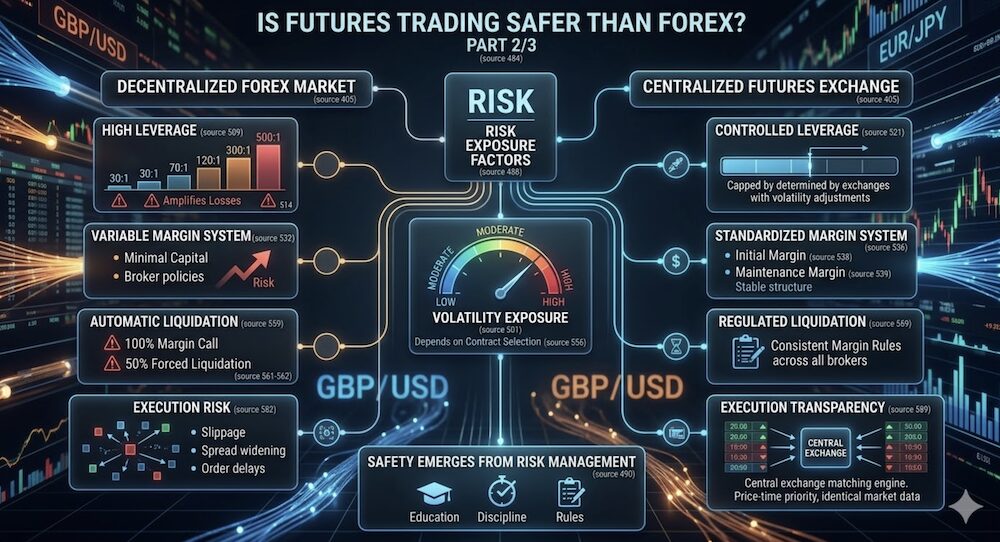
Additionally, brokers typically offer leverage, sometimes exceeding 100:1 or even 500:1, depending on the jurisdiction.
Although leverage magnifies potential profits, it simultaneously amplifies losses. Consequently, inexperienced traders often underestimate the speed at which leveraged positions can move against them.
Key Characteristics of Forex Trading
Several features define the forex market:
Feature | Description |
Decentralized structure | Trades occur through broker networks rather than a central exchange |
High liquidity | Massive daily trading volume |
Continuous trading | 24-hour weekday trading |
High leverage availability | Often far greater than futures markets |
Broker-based pricing | Prices depend on broker liquidity providers |
Because pricing comes from broker liquidity feeds rather than a single exchange, slight price differences may occur between platforms.
What Is Futures Trading?
Understanding Futures Contracts
Futures trading involves standardized contracts that obligate traders to buy or sell an asset at a predetermined price on a future date.
These assets may include:
- Stock indices
- Commodities
- Currencies
- Interest rates
- Energy products
Unlike forex, futures contracts trade on centralized exchanges.
Major futures exchanges include:
- Chicago Mercantile Exchange
- Intercontinental Exchange
Because every trade passes through these regulated exchanges, price discovery becomes highly transparent.
Standardization and Contract Specifications
Each futures contract contains standardized elements such as:
- Contract size
- Tick value
- Expiration date
- Margin requirements
For example, a crude oil futures contract represents a specific number of barrels, while an index futures contract tracks the value of a stock index.
Standardization simplifies trading because all participants operate under identical contract conditions.
Central Clearing and Counterparty Protection
Another crucial feature involves clearinghouses. When traders enter futures contracts, clearinghouses guarantee settlement.
Instead of traders facing each other directly, the clearinghouse becomes the counterparty.
Therefore, counterparty risk dramatically decreases compared with decentralized markets.
Centralized vs Decentralized Markets
Why Market Structure Matters
When evaluating the question Is Futures Trading Safer Than Forex, market structure becomes one of the most important considerations.
Forex operates through a decentralized dealer network. Futures, conversely, operate on regulated centralized exchanges.
This structural difference affects several safety factors simultaneously.
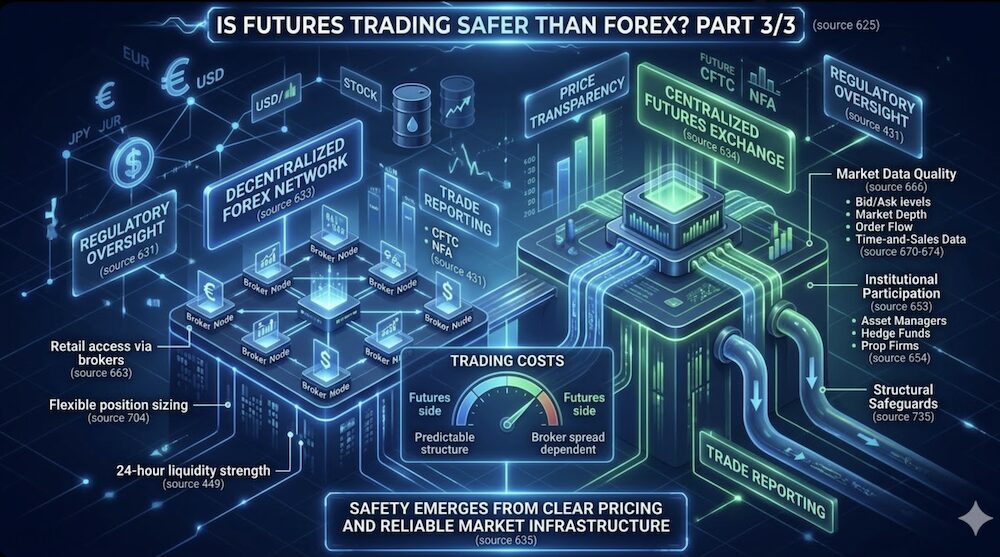
Price Transparency
Firstly, centralized exchanges display all bids and offers in an order book.
Consequently, traders can see:
- Market depth
- Order flow
- Real transaction prices
Forex traders often rely on broker-provided quotes instead. Although reputable brokers provide reliable pricing, traders must trust that feeds reflect actual market conditions.
Trade Reporting
Futures exchanges record every transaction publicly. Because of this transparency, market manipulation becomes harder.
In contrast, forex transactions occur privately between participants. Therefore, verifying exact market-wide pricing becomes more challenging.
Execution Consistency
Execution quality also differs significantly.
In futures markets:
- Orders match through exchange engines
- Slippage occurs due to liquidity conditions
However, forex brokers may use different execution models, including:
- Market maker
- ECN (Electronic Communication Network)
- STP (Straight Through Processing)
While many brokers operate fairly, conflicts of interest sometimes arise with market-maker models.
Regulation Differences Between Futures and Forex
Futures Market Oversight
Futures markets operate under strict regulatory supervision.
In the United States, oversight primarily comes from:
- Commodity Futures Trading Commission
- National Futures Association
These organizations enforce rules covering:
- Margin requirements
- Trade reporting
- Broker conduct
- Market surveillance
Because exchanges must follow these regulations, traders receive significant structural protections.
Forex Regulation Challenges
Forex regulation varies widely between countries.
Some jurisdictions enforce strict oversight. Others provide minimal supervision.
Consequently, broker quality differs dramatically across regions.
Reputable forex regulators include:
- Financial Conduct Authority
- Australian Securities and Investments Commission
Nevertheless, many offshore brokers operate with limited oversight. Therefore, traders must carefully evaluate broker credibility before opening accounts.
Liquidity Comparison Between Futures and Forex
Forex Liquidity Strength
Forex remains the most liquid market globally. Daily trading volume exceeds $7 trillion.
Such immense liquidity ensures that major currency pairs typically experience tight spreads and smooth price movement.
Futures Liquidity Concentration
Futures markets, although smaller overall, concentrate liquidity in specific contracts.
Highly liquid contracts include:
- S&P 500 futures
- Treasury futures
- Crude oil futures
- Major currency futures
Because liquidity concentrates in these contracts, spreads often remain extremely tight during active sessions.
Why Beginners Ask: Is Futures Trading Safer Than Forex
Several reasons explain why traders frequently raise this question.
Firstly, stories about forex broker manipulation circulate widely online. Secondly, centralized futures exchanges appear more transparent.
Additionally, futures margin requirements sometimes limit excessive leverage. Therefore, traders may experience reduced risk exposure compared with highly leveraged forex accounts.
However, safety ultimately depends on risk management, strategy, and trader discipline rather than market choice alone.
FAQs About Is Futures Trading Safer Than Forex
1. Is futures trading more regulated than forex?
Generally, yes. Futures markets operate on centralized exchanges with strong regulatory oversight. Forex regulation varies depending on the broker and jurisdiction.
2. Do futures markets have less manipulation than forex?
Because futures trades occur on transparent exchanges, manipulation tends to be more difficult compared with decentralized markets.
3. Which market has higher leverage?
Forex brokers typically offer much higher leverage than futures exchanges.
4. Are futures better for beginners?
Not necessarily. Futures contracts require understanding margin, tick values, and contract expiration.
5. Can forex trading be safe?
Absolutely. Using regulated brokers, proper risk management, and reasonable leverage can significantly improve safety.
6. Do professional traders prefer futures or forex?
Both markets attract professionals. However, many institutional traders prefer futures due to transparency and centralized clearing.
Conclusion
Determining Is Futures Trading Safer Than Forex requires understanding how each market operates beneath the surface.
Forex offers enormous liquidity and accessibility, yet its decentralized structure introduces certain risks related to broker practices and price transparency. Futures markets, in contrast, provide centralized exchanges, strict regulation, and standardized contracts.
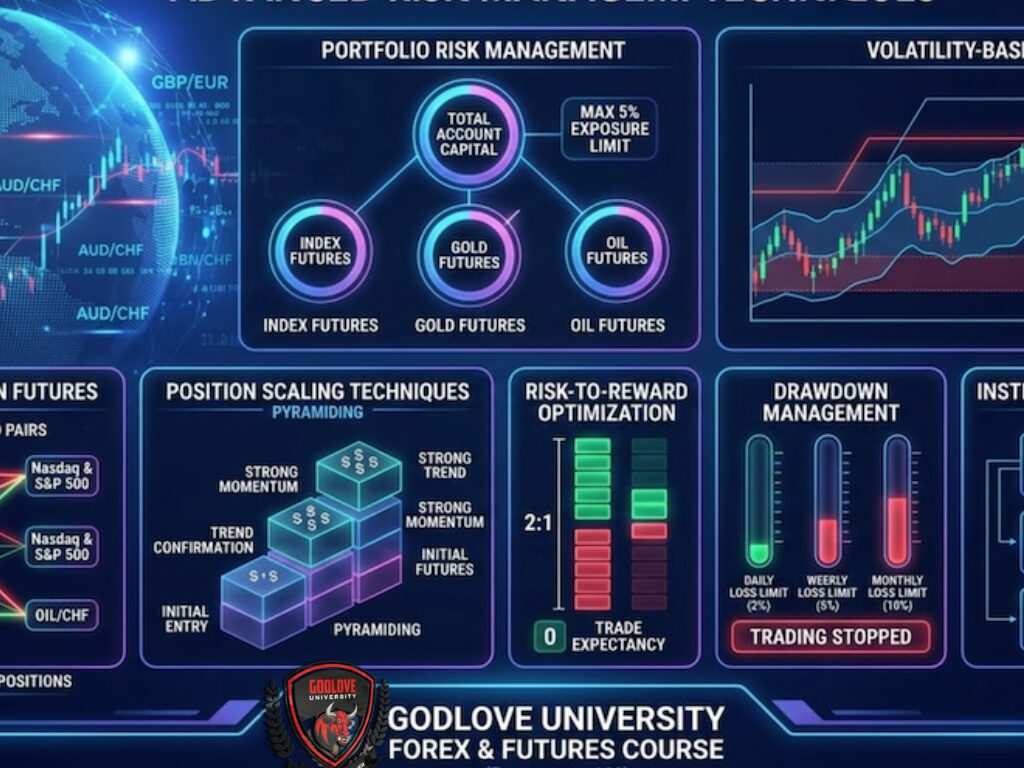
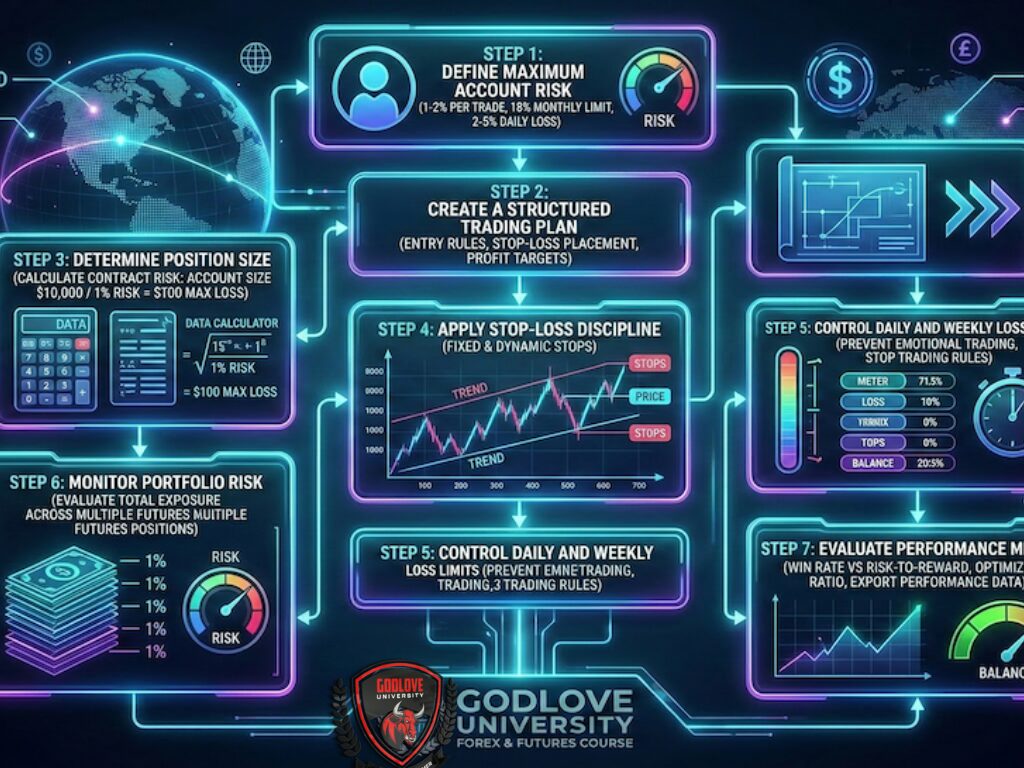
Nevertheless, no market eliminates trading risk entirely. Discipline, strategy, and proper education ultimately determine long-term success.
In the next article of this series, we will examine risk exposure, leverage mechanics, and margin systems, revealing deeper insights into which market may truly offer greater protection for traders.
Useful Links
- Learn this and more with the Complete A to Z Forex & Futures Course
- Automate Your Trading with the Award Winning Patrex Pro Forex Bot